What are the essential CPSC compliance requirements for children's toys?
U.S. toy compliance starts with ASTM F963-23, but lead and phthalate limits, CPC testing, warnings, tracking labels, and 2026 import eFiling may also apply.
Last reviewed: October 18, 2026. This article is general information, not legal advice. Verify current CPSC rules before relying on it.
Short answer: To sell a toy in the United States, the responsible manufacturer or importer must identify the applicable CPSC rules, comply with the mandatory toy safety standard, complete required testing, and issue a Children's Product Certificate (CPC) when required. Other key requirements may include limits on lead and phthalates, small-parts protections, warning labels, and tracking labels. Most imported products subject to CPSC certification must also meet the eFiling requirements now in effect.
The exact requirements depend on a toy's intended age group, materials, design, and features. A plush toy, a building set, and a battery-operated toy may have different compliance obligations.
Which toys are covered by CPSC requirements?
The mandatory toy standard generally covers playthings designed, manufactured, or marketed for children under 14. However, CPSC's children's-product testing and certification requirements generally apply to products intended primarily for children 12 and younger.
Age grading matters. Assess the toy's design, marketing, and intended play—not just the age printed on the package. CPSC's Toy Safety Business Guidance explains the scope and related requirements.
1. Comply with ASTM F963-23
The CPSC-mandated toy safety standard is ASTM F963, incorporated into federal regulations under 16 CFR Part 1250. As of October 2026, ASTM F963-23 applies to toys manufactured on or after April 20, 2024.
Depending on the toy, the standard may address mechanical and physical hazards, sharp edges and points, cords, sound levels, projectiles, magnets, batteries, and other product-specific risks. Not every section applies to every toy. Manufacturers should identify the applicable sections and testing requirements using the CPSC's ASTM F963 requirements chart.
ASTM F963 does not replace every other CPSC rule. Separate requirements may also apply to lead, phthalates, small parts, or specific toy categories.
2. Meet lead and phthalate limits
Children's toys may be subject to separate chemical restrictions under the CPSIA:
- Total lead: Accessible component parts of a children's product generally may not contain more than 100 parts per million (ppm) of lead.
- Lead in paint and similar surface coatings: The limit is 90 ppm.
- Phthalates: More than 0.1% (1,000 ppm) of any prohibited phthalate in an accessible plasticized component of a children's toy or child-care article is not allowed. The eight restricted phthalates are DEHP, DBP, BBP, DINP, DIBP, DPENP, DHEXP, and DCHP.
These limits apply to specific materials or accessible components, so a product-wide average may not be enough to establish compliance. Review CPSC guidance on lead content, lead in paint, and phthalates.
3. Complete required testing and issue a CPC
When a children's toy is subject to CPSC-enforced safety rules, the responsible U.S. manufacturer or importer generally must certify compliance in a Children's Product Certificate (CPC). Required third-party testing must be performed by a laboratory accepted by the CPSC for the relevant test.
The manufacturer or importer—not the laboratory or the CPSC—issues the CPC. The certificate identifies the product and applicable rules, along with required manufacturing, testing, and laboratory information. Some testing exemptions may apply, but an exemption does not automatically remove the obligation to comply or issue a CPC.
See CPSC's Children's Product Certificate guidance for current certificate requirements.
4. Address small-parts hazards and warning labels
Under 16 CFR Part 1501, toys intended for children under 3 must not contain small parts that present a choking, aspiration, or ingestion hazard. The rule also considers parts that detach during simulated use-and-abuse testing.
Some toys intended for older children that contain small parts, small balls, marbles, or balloons require specific choking-hazard warnings. A warning label does not make a small part permissible in a toy intended for children under 3. Check CPSC's small-parts and choking-hazard guidance.
Other toys may require age grading, warnings, or instructions based on their design and intended use.
5. Add tracking labels to the toy and packaging
Children's products generally need permanent, visible, and legible tracking information on the product and its packaging, to the extent practicable. This information should make it possible to identify the manufacturer or importer, production location and date, and batch, run, or other identifying details.
Tracking labels support traceability if a safety issue or recall occurs. They are separate from the CPC. Read the CPSC's tracking-label guidance.
6. Check requirements for batteries and other toy features
Battery-operated toys have additional requirements under ASTM F963, including provisions related to battery access, warnings, and overheating. Toys that contain button-cell or coin batteries and comply with the applicable toy requirements in 16 CFR Part 1250 are exempt from the general consumer-product standard in 16 CFR Part 1263. That exemption does not remove the toy's ASTM F963 obligations. Separate packaging rules may apply when button-cell or coin batteries are supplied separately.
Toys with magnets, projectiles, loud sounds, cords, or other specific features may have additional requirements. Review CPSC's button-cell and coin-battery guidance and the applicable sections of ASTM F963.
7. Complete import eFiling where required
As of July 8, 2026, importers of most consumer products subject to CPSC certification must electronically file required certificate data with U.S. Customs and Border Protection through the Partner Government Agency (PGA) Message Set. Products imported through a Foreign Trade Zone and later entered for consumption or warehousing have a separate effective date of January 8, 2027.
eFiling does not replace testing or the CPC. It adds an import-data filing requirement. Check the CPSC's certificate and eFiling update for current applicability.
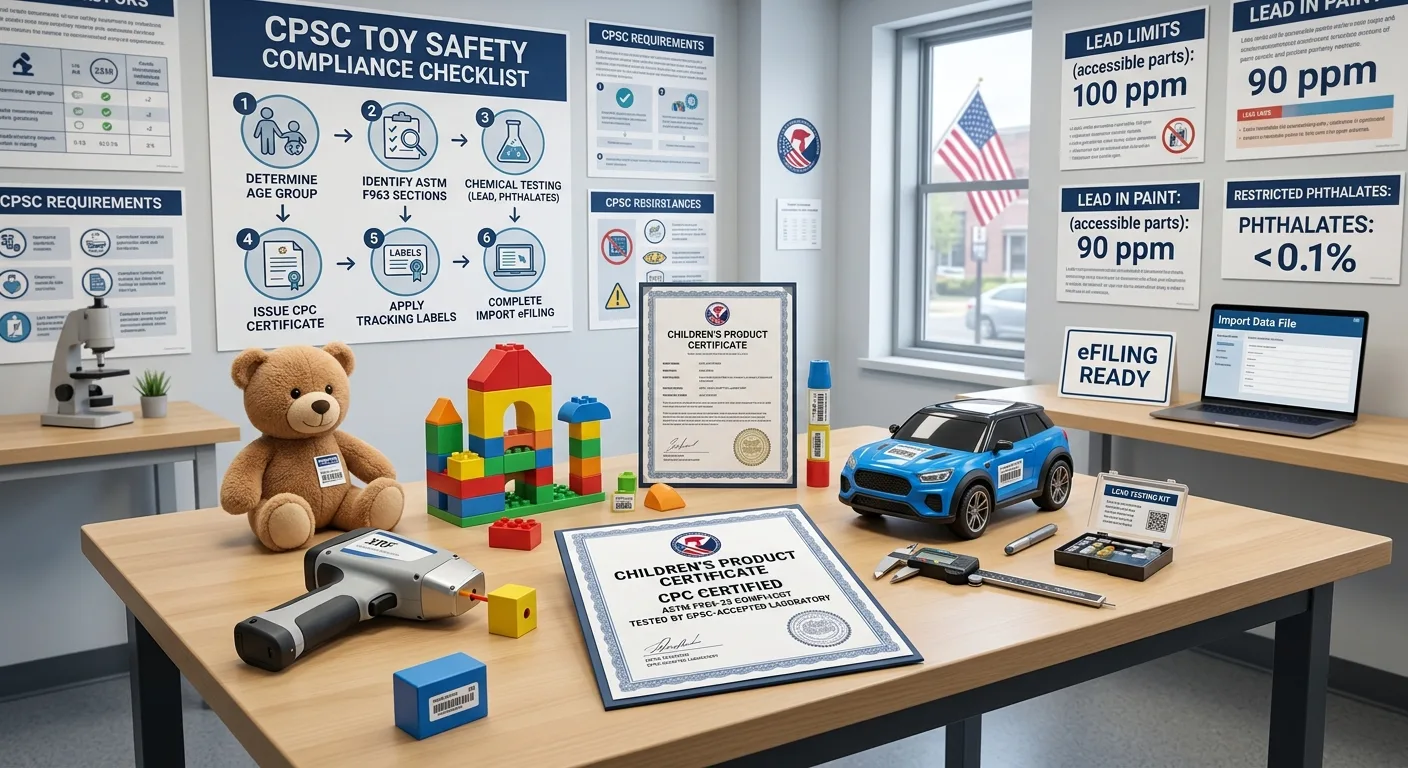
CPSC toy compliance checklist
Before launching or importing a toy, confirm that you have:
- Determined the intended age group and applicable CPSC rules.
- Identified the relevant ASTM F963 sections and any separate requirements.
- Reviewed materials and accessible components for lead, phthalates, and other hazards.
- Completed required testing with a CPSC-accepted laboratory.
- Issued and maintained the applicable CPC and supporting records.
- Applied required warnings, instructions, and tracking labels.
- Prepared import eFiling data if the product and shipment are covered.
Frequently asked questions
Does the CPSC issue a certificate for toys?
No. The CPSC does not issue a toy approval certificate. The manufacturer or importer issues the CPC based on the required compliance information and test results.
What is the lead limit for children's toys?
The general total-lead limit is 100 ppm in accessible component parts. Lead in paint and similar surface coatings is limited to 90 ppm.
Is ASTM F963-23 mandatory?
Yes. Under 16 CFR Part 1250, ASTM F963-23 applies to toys manufactured on or after April 20, 2024. Check CPSC guidance for the sections that apply to a specific toy.
Are small parts allowed if the package has a warning?
Not in toys intended for children under 3 when the parts present a hazard covered by the small-parts ban. Some toys for older children may require a choking-hazard warning.
Do all imported toys require eFiling?
No. The requirement applies to most imported products subject to CPSC certification, with specific applicability rules. Importers should check current CPSC eFiling guidance for their product and shipment.
Planning a U.S. toy launch? Contact M&Z Consulting to discuss the requirements that may apply to your product and the steps to take before importing or selling it.
This article provides general information, not legal advice. Requirements can vary by product and may change; verify the current CPSC rules and guidance before relying on this summary.